"What Is Buddhist Aesthetics?" Part I of a Series / Eshō Jōken
Introduction
Today, Mingei is being discussed from many different perspectives. The question of what Mingei truly was has once again come to the fore. Indeed, rather than regarding it as something belonging to the past, one might say that contemporary society is only now beginning to catch up with the thought of Sōetsu Yanagi (1889–1961). Put another way, Yanagi may have been looking more than a century ahead of his time. Tradition, handcraft, rural communities, everyday life, and the very meaning of living: Mingei has once again drawn the attention of many people, offering an entrance for things that contemporary society is in danger of losing sight of.
Yet there is one aspect of Yanagi’s thought that has received comparatively little attention: Buddhist Aesthetics, perhaps the culmination of his life's work. Although he articulated this philosophy in the postwar years, its foundations lay at the very heart of his thought throughout his life.
Yanagi argued that true beauty does not arise from the binary opposition between what is beautiful and what is ugly. Rather, it is the beauty inherent in things as they are. His understanding of beauty is grounded in the Buddhist concepts of funi (non-duality) and soku (the inseparable unity of things that remain distinct), and points to the essential kinship between what religion and beauty seek.
In any case, to bring together the concerns of faith and beauty is not at all strange. In fact, to me it seems rather late in the day for people to be recognizing the intimate kinship between them. The sacred religious words which tell of faith whisper in the same breath the inner meanings of beauty. No one can speak more profoundly, or more penetratingly, of the intrinsic nature of beauty than the words of the scriptures. How should they? Beauty, like religion, is a manifestation of the ultimate. At least apart from that ultimate, true beauty is inconceivable.”
Sōetsu Yanagi, The Dharma Gate of Beauty (1948), translated by Bernard Leach
Buddhist Aesthetics expresses the idea that beauty and religion are inseparable, since both are concerned with revealing that which is ultimate. It may be understood as an attempt to clarify the foundations of the “uncontrived beauty” that Mingei thought has always held as its ideal.
And yet, perhaps because of the word “Buddhist” in its name, Buddhist Aesthetics seems to have struggled to find acceptance in wider society. Its subject matter touches on an intensely religious realm, one concerned with the liberation of human beings. At one time, Yanagi’s thought was even derisively referred to as “Yanagi-ism” or “the Yanagi religion.” Given that Mingei is fundamentally a philosophy that questions the very nature of human life, perhaps its movement into the religious realm was only a natural consequence.
In contemporary society, however, where speaking openly about religion has become difficult, Mingei philosophy has found acceptance while Buddhist Aesthetics has remained relatively unfamiliar. At the same time, although fewer contemporary movements explicitly call themselves “religion,” many things with a distinctly religious character are emerging. Perhaps the time has come to reconsider Buddhist Aesthetics.
I believe that this unique position, where Buddhist Aesthetics flows between religion and beauty, has the potential to respond to both the spiritual and aesthetic aspirations of many people. I am also convinced that it can offer a sure guiding principle for life.
The Background to the Emergence of Buddhist Aesthetics
How did Buddhist Aesthetics come into being? Its starting point was The Dharma Gate of Beauty, written in 1948. Let us look at the circumstances that led to its creation. One important figure who helps us trace this background is Daisetsu Suzuki (1870–1966), a world-renowned Buddhist thinker who helped introduce Zen to the West.
When Sōetsu Yanagi was a student at Gakushūin Higher School, at the age of twenty, he studied English with Daisetsu Suzuki, then thirty-nine, who had only recently returned from the West. Suzuki also taught him not only Buddhism but Western mystical thought. Their teacher-student relationship continued throughout their lives.
Among Suzuki’s works, The Facts of Religious Experience (1943) and Japanese Spirituality (1944) had a particularly profound influence on Yanagi. Through these books, Yanagi came to learn about the Myōkōnin, lay devotees of deep faith in Jōdo Shinshū. His encounter with the world of the Myōkōnin would become of immense importance to his postwar thought.
Suzuki describes the Myōkōnin as follows:
Among Pure Land believers those particularly rich in faith and goodness are called Myokonin, literally, the ‘wondrous good men. Myōkōnin is not someone distinguished by scholarship or by the ability to debate religious doctrine. Rather, such a person has personally absorbed the teachings of the Pure Land tradition and embodies them in everyday life”
Daisetsu Suzuki, Japanese Spirituality (1944), translated by Norman Waddell
Yanagi, too, was deeply moved by the lives of these devotees:
We must reflect deeply on the fact that the Dharma is, in truth, often more vividly alive among poor and nameless believers.”
Sōetsu Yanagi, Shinnyo Osono (1959)
“One might even think that the hundreds and thousands of teachings of the Dharma, and its countless words, have all been expounded for the sole purpose of giving rise to Myōkōnin. The Ōjōyōshū, the Senchakushū, and the Kyōgyōshinshō: one could say that the very essence of all these teachings has crystallized in the Myōkōnin.”
Sōetsu Yanagi, Myōkōnin (1960)
For both Suzuki and Yanagi, the Myōkōnin were people who embodied the teachings of Pure Land Buddhism. The term Myōkōnin itself is discribed in The Contemplation Sutra. The sutra states:
“Those who recite the Buddha’s Name should know that such people are white lotus flowers among humankind.” The Contemplation Sutra
The Sanskrit term Pundarīka was rendered phonetically in Chinese as Fundarike (分陀利華), and its meaning was interpreted as “wondrous and beautiful flower,” or “white lotus.” The image is that of a pure white lotus blossoming unstained from the mud. By analogy, those who live according to the Dharma while remaining in this world of suffering have been praised as Myōkōnin. As Suzuki and Yanagi both point out, such people did not necessarily emerge from among priests or scholars. Many were found among ordinary people living in their communities.
Visiting Dōshū, a Myōkōnin of Akao
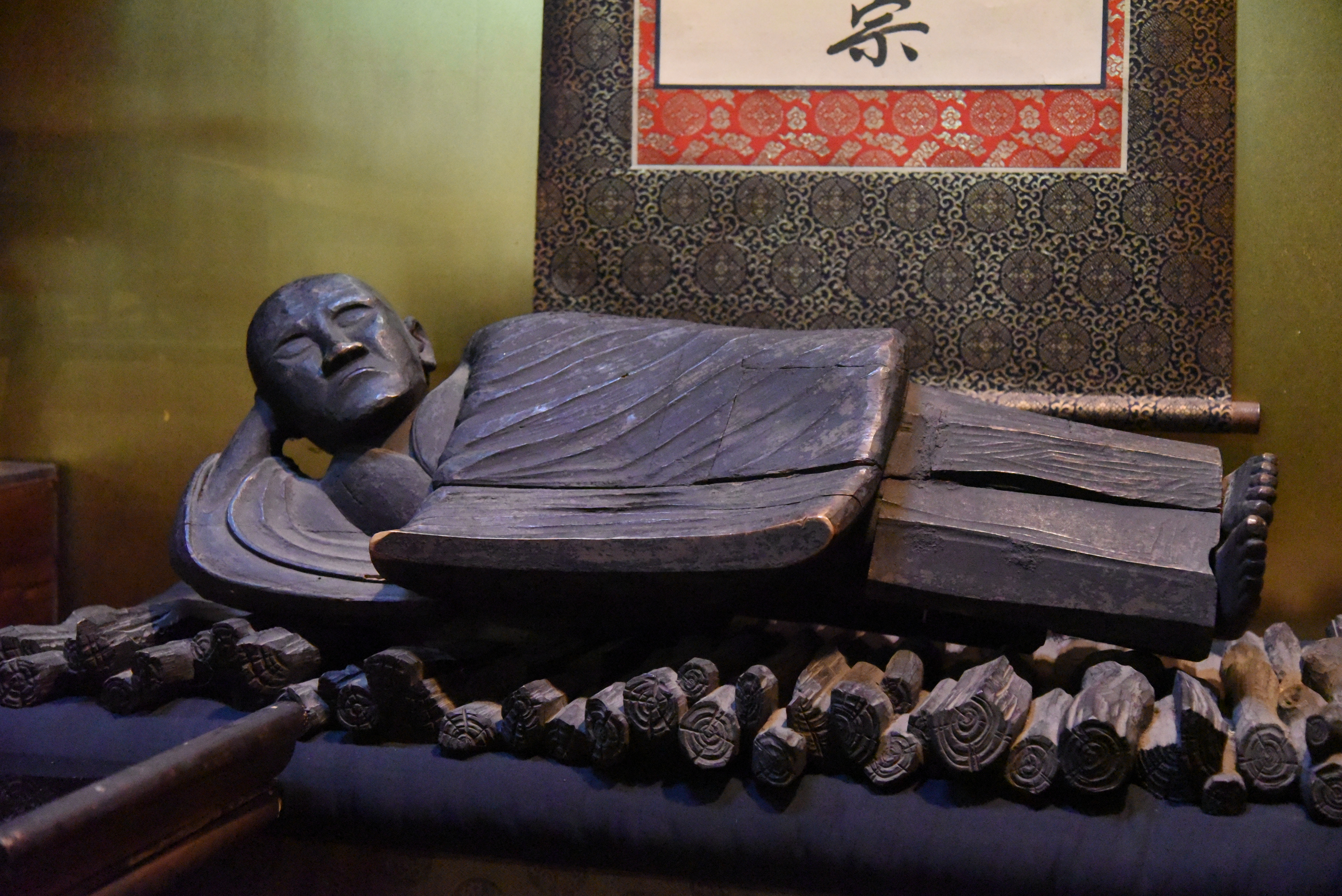
Statue of Dōshū in His Daily Life, Collection of Gyōtokuji Temple
In Japanese Spirituality, Suzuki discusses two Myōkōnin in particular: Saichi Asahara(1850–1932), from Yunotsu in Iwami Province, and Dōshū (d. 1516), from Akao in Gokayama, Etchū Province, in what is now Toyama Prefecture.
Yanagi was especially drawn to Dōshū of Akao. In order to follow in his footsteps, Yanagi travelled to Jōhana, the gateway to the remote mountain region of Gokayama, accompanied by Kanjirō Kawai, Shōji Hamada, Shikō Munakata, and Kichinosuke Tonomura.
On May 27, 1946, guided by the local Buddhist priests Kanshō Kōsaka and Renshū Ishiguro, the group stayed at Zentokuji, a temple of the Ōtani-ha branch of Jōdo Shinshū in what is now Nanto City. From the following day until May 30, they visited sites associated with Dōshū throughout Gokayama.
Dōshū was one of the most devoted disciples of Rennyo (1415–1499), the eighth head priest of Hongwanji. His rigorous commitment to the Buddhist teachings is preserved in a collection known as The Twenty-One Principles of Dōshū of Akao.
Among them are the following:
“First: The great matter of the life to come. As long as life remains, one must never be heedless of it.”
“First: If I should live through today and tomorrow, yet afterward neglect the Dharma, I should be ashamed of myself, tear this away, and admonish myself.”
“First: In all things, do not become attached in your heart. Rather, I earnestly wish that my heart may be devoted deeply to this one great matter alone.”
Excerpts from The Twenty-One Principles of Dōshū of Akao, compiled by Gyōtokuji
Yanagi later recalled how deeply these principles had moved him.
Dōshū had lost his parents at an early age. One day, a traveling monk told him, “If you meet Rennyo Shōnin, you may encounter a parent who will never part from you: Amida Buddha.” Guided by these words, Dōshū went to Rennyo and spent many years listening to his teachings.
After returning to his native Gokayama, Dōshū made a monthly pilgrimage to Zuisenji Temple in Inami, a journey of some thirty kilometres from his home. He never neglected this practice. Gokayama is surrounded by steep and rugged mountains, and even the sight of these ranges conveys something of the extraordinary resolve with which Dōshū must have undertaken his journeys.
It is also said that, in order never to forget the Buddha’s boundless benevolence, Dōshū slept at night on forty-eight pieces of split firewood, recalling the forty-eight vows of Amida Buddha. This practice is remembered in the image known as Dōshū Gyōga-zō, depicting Dōshū in his austere sleeping posture.
Dōshū founded Gyōtokuji Temple in Gokayama, and the Dharma lineage he established has been passed down through his descendants to this day. When Shikō Munakata visited the temple, he was so deeply moved by the extraordinary figure of Dōshū that he immediately created a woodblock print of it and presented the work to the temple.
Through his encounter with Dōshū’s life and practice in Gokayama, Yanagi was profoundly impressed by the fact that the Dharma lineage had continued to live on among the local people, not merely as a historical legacy but as a living faith.
Encountering the Colored-Paper Wasan
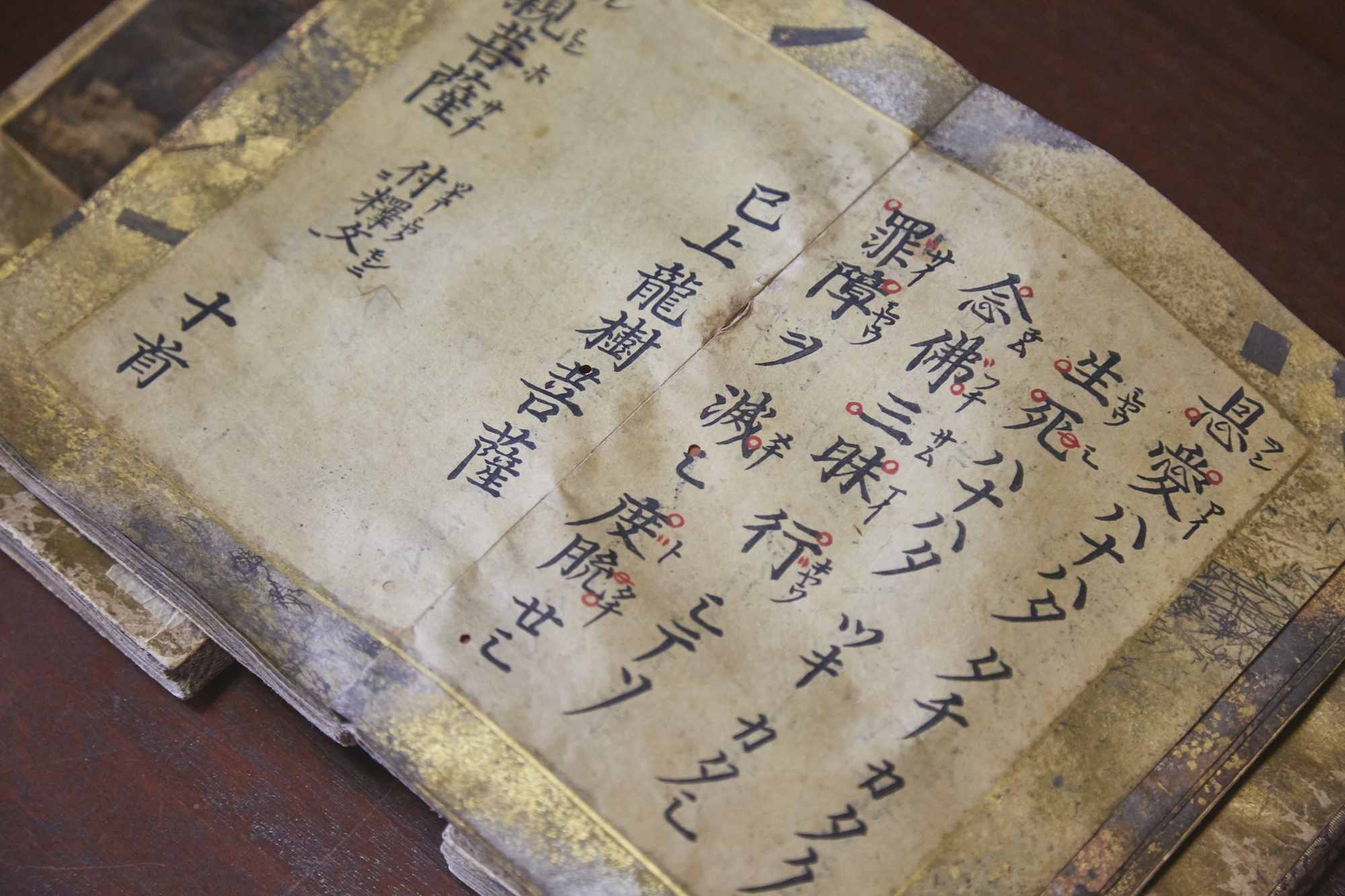
Colored-Paper Wasan (Decorated Edition of the Sanjō Wasan)
Collection of Jōhana Betsuin Zentokuji Temple
On the morning of May 28, as the group was preparing to enter Gokayama, Kanshō Kōsaka guided Yanagi and his companions to view a volume of wasan preserved at Jōhana Betsuin.
Wasan are religious verses composed in Japanese by Shinran (1173–1263), the founder of Jōdo Shinshū, expressing the teachings of the tradition in a seven-five syllabic rhythm. Since the time of Rennyo, the daily recitation of wasan has been an integral part of the lives of Shin Buddhist followers.
The volume Yanagi saw was made up of alternating pages of red and yellowish-brown colored paper, with verses printed in a mixture of Chinese characters and Japanese kana. Yanagi was deeply struck by the extraordinary beauty of this shikishi wasan, or colored-paper wasan, whose beauty emerged from the combination of its exquisite paper and printed characters.
He later wrote:
I could not help but cry out in admiration. Never in my life had I seen such a beautiful printed book. [...] It was not merely elegant, nor was it merely gentle. The colors, the characters, the manner of printing: everything was assured and sound.”
Sōetsu Yanagi, On the Colored-Paper Wasan (1947)
What this colored-paper wasan embodied was a beauty that was “assured and sound”: precisely the kind of beauty Yanagi had come to recognize in Mingei. Moreover, printed editions of wasan were objects created to make the teachings of the Dharma accessible to ordinary people and nurture their faith. In this sense, their practical purpose lay in bringing the people and faith into a living relationship. Before Yanagi’s eyes, the colored-paper wasan appeared as an object in which faith and beauty were organically united.
While the excitement of this encounter was still fresh, Yanagi went on to visit Dōshū’s sites in Gokayama. We can imagine that, in his mind, the faith embodied by the Myōkōnin and the exquisite colored-paper wasan, printed with the sacred words that had nurtured such people, resonated with one another and became inseparably intertwined.
After leaving Jōhana, the following year in June, Yanagi visit second-hand bookstores in Kyoto. He was looking for Buddhist books, but deep in his heart he was still thinking of the colored-paper wasan he had seen.
Knowing that it was a long shot, Yanagi visited one shop after another. Miraculously, he came across a wasan written on colored paper that closely resembled the version held by Jōhana Betsuin, though it differed in whether or not it was decorated. He finally succeeded in purchasing it.
It seems reasonable to regard Yanagi’s encounters with the Myōkōnin and the colored-paper wasan in Jōhana and Gokayama as experiences that prompted a profound deepening of the theory of Mingei beauty he had developed over the years.
Yanagi wrote:
The wonder of Shin Buddhism flashes forth most brilliantly among the unlearned people. Do not the many Myōkōnin move our hearts through their brief words, their utterly pure conduct, and their simple faith? And the bond between the people and faith extends also to the relationship between the people and beauty. The reason Mingei draws us so strongly is that we find among these objects many things that might well be called ‘Myōkōhin.’ Is it not the teaching of the Nembutsu that so profoundly reveals the law of beauty flowing through such objects? A single copy of the Tannishō, or a single volume of the Anjin Ketsujōshō, seems to me a scripture of beauty.”
Sōetsu Yanagi, Myōkōnin
From this point onward, Yanagi began to call Mingei objects Myōkōhin, a term combining myōkō (妙好), “wondrous beauty,” and hin (品), “objects” or “things”, drawing an analogy between them and the Myōkōnin.
It was Daisetsu Suzuki’s Japanese Spirituality that first brought the Myōkōnin to public attention as a subject of religious philosophy and scholarly inquiry, preceding even the scholars of Shin Buddhist doctrine. Until then, the Myōkōnin had received very little attention within the Shin Buddhist establishment itself. Yanagi commented on this as follows:
This situation closely resembles the fact that, until today, aestheticians and art historians have given no consideration to works created by ordinary people, namely, Mingei objects. Yet just as beauty is expressed in these objects in the most direct and unrestrained manner, there can be no doubt that the profound truth of the Dharma takes concrete form and appears with complete openness and clarity in the words and deeds of the Myōkōnin.”
Sōetsu Yanagi, The Existence of the Myōkōnin (1960)
Yanagi saw the embodiment of the ultimate reality of “beauty” in Mingei objects as operating according to the same principle as the embodiment of the ultimate truth of the “Dharma” in the Myōkōnin.
For Yanagi, his conviction about the relationship between beauty and faith opened the way to the realization of bi-shin ichinyo, the oneness of beauty and faith. It was this insight that led him to deepen his theory of Mingei beauty into Buddhist Aesthetics.
Writing The Dharma Gate of Beauty
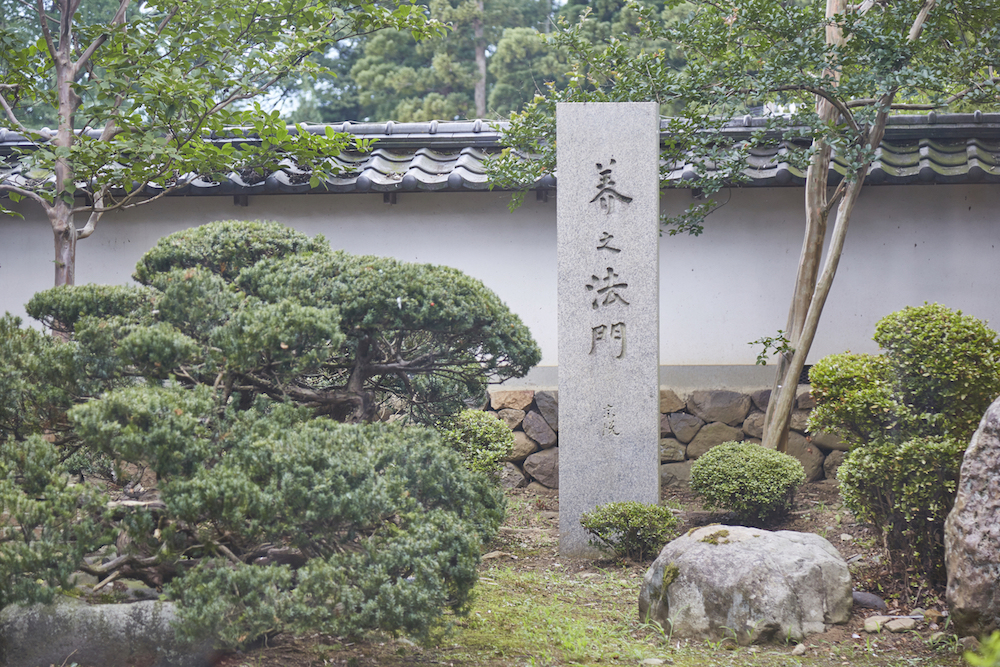
The Stone Monument to The Dharma Gate of Beauty, erected by Shikō Munakata, Renju Ishiguro, and others, Jōhana Betsuin Zentokuji Temple
Approximately two years after his encounters with the Myōkōnin and the colored-paper wasan, on July 19, 1948, Yanagi visited Jōhana Betsuin to put into words his intuition of bi-shin ichinyo, the oneness of beauty and faith. He stayed there for 62 days, until September 18. One day during his stay, as he was leafing through the Larger Sutra of Eternal Life, a Buddhist scripture of the Pure Land tradition, his attention was suddenly drawn to the Fourth of Amida Buddha’s Forty-eight Vows, known as the “Vow on No-Beauty-nor-Ugliness” (Mu-u-kō-zhū no Gan, 無有好醜の願).
The passage reads:
If, when I attain Buddhahood, the human and heavenly beings in my land should have different forms and colors, with some beautiful and others ugly, may I not attain perfect enlightenment.”
The Larger Sutra of Eternal Life
Yanagi intuitively recognized this passage as the foundation for the beauty of Mingei that he had pursued for so many years. He set down his theory under the title The Dharma Gate of Beauty, completing it in the course of a single night.
This work, The Dharma Gate of Beauty, would become the starting point for a new horizon in thought: Buddhist Aesthetics.
On November 4, 1948, Yanagi delivered a lecture on The Dharma Gate of Beauty at the Second National Convention of the Japan Folk Crafts Association, held at Shōkokuji Temple in Kyoto. It is said that Shikō Munakata, deeply moved by the lecture, embraced Yanagi with tears streaming down his face.
That same month, while visiting Yoshida Shōya, who was preparing to open the Tottori Folk Crafts Museum, Yanagi heard from a haiku poet named Kansai about the existence of Genza Ashikaga, a Myōkōnin from Inaba Province.
Genza had lived until 1930, which meant that he had passed away only eighteen years earlier. For Yanagi, he was therefore a Myōkōnin who had lived in the very same era as himself.
From then on, Yanagi devoted himself to the study of Genza. This was not simply an exercise in biographical research. It was an attempt to encounter and verify a living embodiment of the oneness of beauty and faith. In time, this endeavor would become an essential part of his work toward establishing Buddhist Aesthetics.
[To be continued in Part II]
Eshō Jōken
Head Priest of Jōkenji Temple, Jōdo Shinshū Hongwanji-ha
President of the Society for Buddhist Aesthetics