わたしと民藝の出会い ジヒとかフニとか My Encounter with Mingei: Jihi and Funi
藪谷智恵 Chie Yabutani
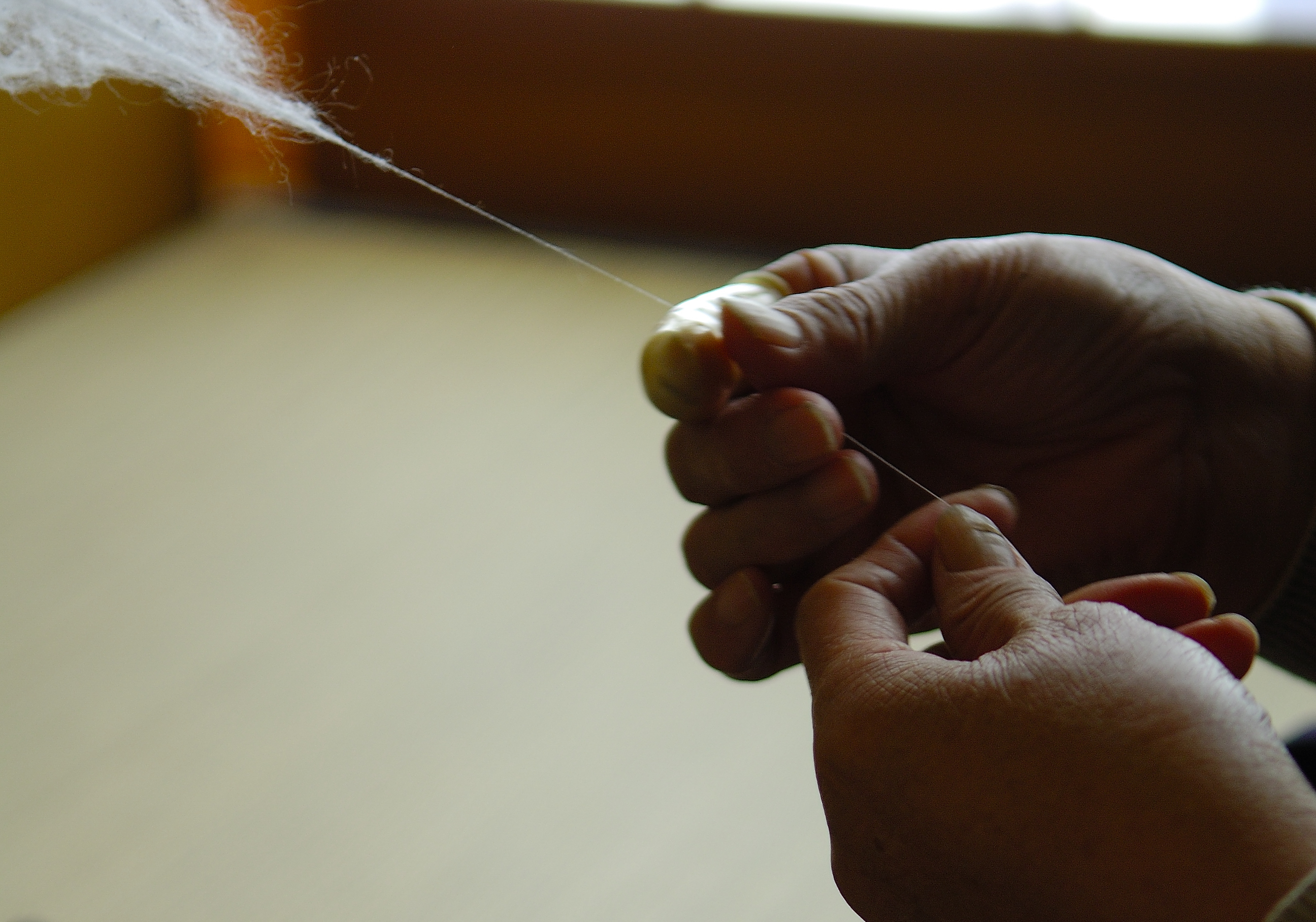
20代の頃、結城紬という布の産地で働いていました。結城紬は、真綿という、繭をやわらかく煮てから広げたふわふわの絹から、指でつむいだ糸で織る絹織物です。マットな質感と奥ゆかしい絹の光沢、手でつむいだ糸の表情、細やかな意匠のバリエーション等がこのうえなく格好良く、『手仕事の日本』では柳さんにも絶賛されています。
人の指は、素材をいかすことと、律することを同時に行ないます。そのものが美しいことには何らかの霊力がはたらいている、といわれればそれはそうだろうと諒解できる気がします。
ただ結城紬の産地で働いていたことが、かえって「民藝」との距離をつくっている部分もありました。日本で糸から手でつむいで織る布は、現代では「文化財」です。柄が入れば、車が買えるほどの値段になります。
近代化以後、人が使えるようになったエネルギーは、それまでの200倍だそうです。素材から製品までの工程数が多い「布」は、技術革新による価値変化から受ける影響が大きいものです。糸から手でつむぐとなれば、商品として現代社会に合わせるのは難易度が高く、きものを着る人が減っているのだから、洋服にすればいいじゃない?とは簡単にいきません。文化背景、価値の体系、原価構成、どうつくってどう使うかのあれこれが、何から何まで違うのです。
そこでどうする?この布をどうつくって、どう位置づけて、どう見せて、どう売る?を考えるのが産地問屋での私の仕事で、そこでは、民藝との距離も感じるなあ、というのが、民藝に対しての感覚でした。「あまねく」性が難しい、と思っていました。
その後、結婚して、出産と同時に夫の仕事で富山に来ることになりました。富山、特に県西部は、伝統文化や景観と浄土真宗が密接に関わっているところに、民藝が重なっていました。そこではじめて、柳宗悦が宗教哲学者だったことを知りました。知ってあらためて読む柳のテキストには、宗教的な言葉が多用されていて、また、そこに書いてある「もの」が美しくなる原理は、結城紬が美しいこと、まさにそのものでした。

富山に来てからの暮らしは、妊娠、出産、育児という、いのちの場に放り出される経験でもありました。それまでは言語で組み立てられた社会を生きていたのが、全く違うレイヤーがあらわれて、なんの練習もなく、言葉もこれまでの経験値も通じない、ルールが違う場に、とつぜん投げ込まれたようでした。富山は友人も親族もいないまっさらに新しい土地だったので、その感覚がとても鮮明でした。
ほっておいたら消えてしまいそうなまだ弱いいのちに、血を与えて(母乳は白い血液です)、この子と、自分と、生き延びるだけで精一杯。毎日、生きることしかしていない。ときに、多幸感に満ちていて、ときに、剥き出しのいのちがひりひり迫ってくるのがおそろしい。
私は、内側から「母」に塗り替えられていく自我のゆらぎや喪失、言語でできている現代社会と、子どもと自分が置かれているいのちの場の行き来に右往左往していました。「おのずから」変化する身体は、自我ではうまくとらえられないのです。
全員が通ってきた道。けれども記憶にはほとんどない、生後すぐの赤子の暮らし。その存在とともにあることは、この世の裂け目に入るような体験でした。寝れない、身体が痛い、といったこともあるのですが、なんか、そういうことでもなくて。それは、言葉を奪われる経験で、そういうふうに、身体ごと、自我ごと、母体はつくりかえられてしまいます。だからこそ、その経験はまた、圧倒的に言語化されていないのでした。
いうなればそこは、フニに近い場だったのかなと、思います。まだ言葉で環境を文節化する以前の子どもは、世界とわかれず、一体化してあるように見えました。泣くときも、よろこぶときも、全身で、それがそのまま、世界であるようでした。そこにうまく接続できるとき、それは主として私の体が食べ物になるときでしたが、たいへんに満ちる感覚がありました。
民藝、また仏教がいうことは、大人になり社会に適応するために身につけていく、分けて、はからう力を持ちながらも、生まれてきたいのちが持っていた、ということは誰ものなかにある、世界と分かれない感覚を思い出し、つながりのある源泉から、力を得られるようになること、なのでしょうか。
そこは人じゃないもの、他のいきものもみんないる、細胞やDNAのいのちの記憶が蓄積している、フニの、阿頼耶識のレイヤーで、それは子どもがやってきたところ、ということは同様に我らもそこからやってきた、いのちのスープのようなものが想起されます。
いのちのスープ。わかれていないもの。それで、お味噌汁です。
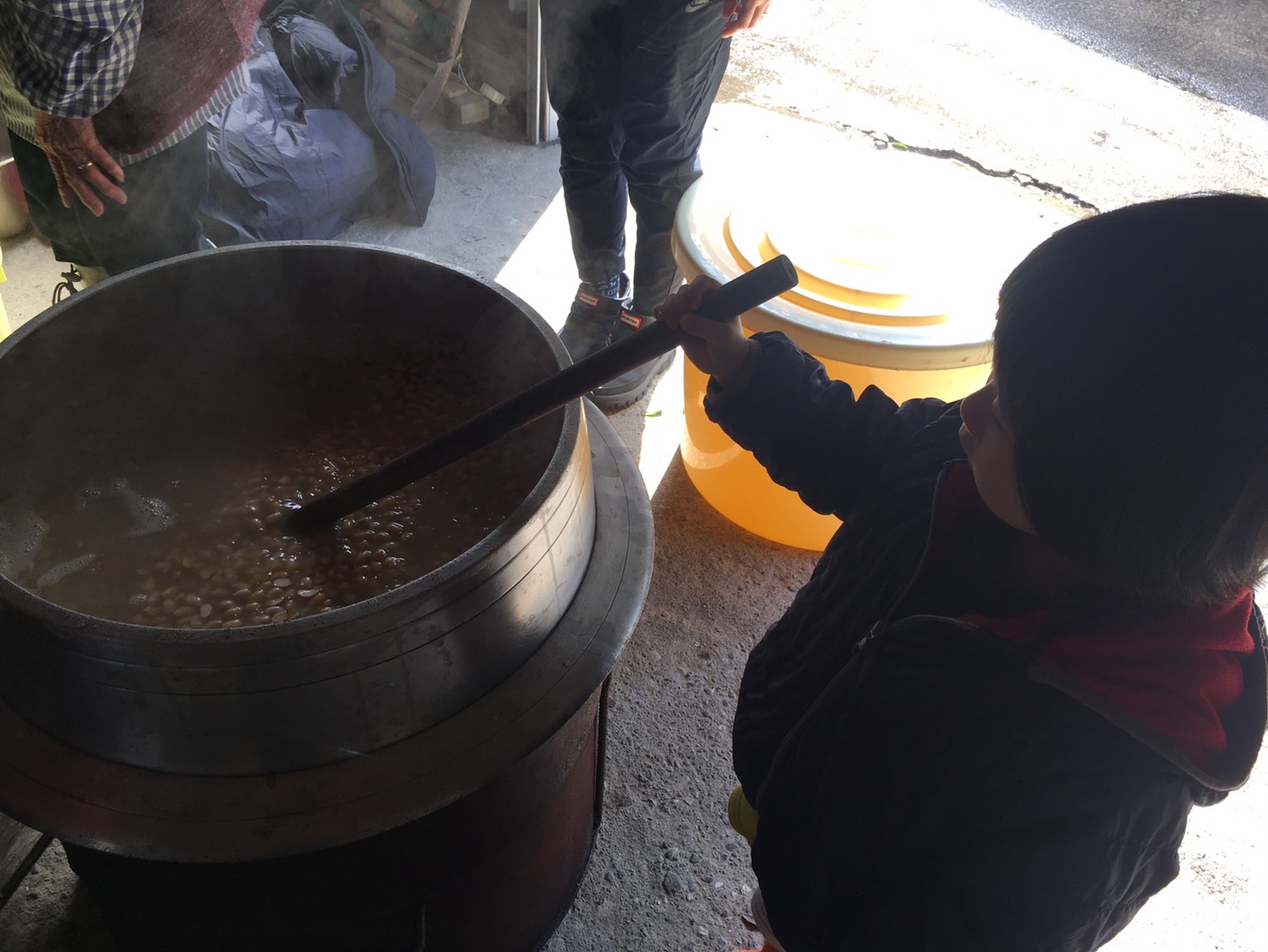
幼い子どもはかわいい、けれどしんどい、大変に不条理な、コントロールできない大自然でした。何でもイヤイヤ、とりあえず拒否、という時期があって、なんで当たり前の一つ一つがこんなに進まないのかと疲れ果て、でもご飯食べなくちゃ、食べさせなくちゃ、食べにいくより買ってくるより結局自分でつくるのがラクというか、イヤイヤしている子どもと一緒に食べに行くのも、食べ物買いに行くのも、けっこう面倒で、シッターサービスとかないし、ファミリーサポートとかは事前に研修とか手続きとかあれこれ云々かんぬんで、なんだかんだ自分でやるのがベターってことでやるしかない、全然やりたくないけど、ああ、前は料理も好きだったんだけどなあと、心底うんざりしながらつくった味噌汁が、しかし、超絶おいしかったことがありました。
それは秋で。牛蒡と、里芋と、鶏肉と、いい出汁の出るメンバーがたまたま揃っていて、は?ってなるほど、信じられないほど、イヤイヤつくったお味噌汁がおいしかったのでした。
おいしくつくろうと思わなくても、味噌のおいしさをつくっている微生物たちのはたらきと、素材から出る出汁と、作り方を意識しなくても味噌汁くらいはつくれる、それなりに何度も料理してきたこの手で、特別なレシピも材料もなく、切って煮るだけで、くたくたのこの家にここにあるままで、こんなにおいしいものが生じる。私がつくったけど私がつくったんじゃないおいしさ。これが他力か!となりました。なんてありがたいんだろう。慈悲がある、と思いました。誰でも、どこでもの、遍く性を実感しました。ジヒジヒ。
民藝というと、つい定義から考えていたけれど、「民藝は凡夫でもおいしさをうみだせる運動性の原理とそのワンダーだ!」と思いました。
それが民藝との出会いでした。
今では、価格が高価になるからといって、またきものに慣れないからといって、結城紬に、伝統布に、和装に、あまねく性がないことはない、と感じています。必ず道はあって、誰もにひらかれています。
嗜好品化している手仕事を、なければなくて良いものと感じる向きもあるかと思いますが、私は結城紬のおかげで生きる力が身についたので、必ず要るものと確信しています。工藝はフニと人をつなぐ窓。布の、包まれることでもたらされる体感も大きなものです。必ずしも結城紬でなくてもいい、けれどもそういったものは、やはり誰もに必要だと思います。
最後に、最近まとめさせていただいた城端別院善徳寺さんの「他力」と「本願」の定義に痺れましたので、記したいと思います。
他力とは、自分を生きさせるはたらき。
本願とは、自分のいのちが本来持っている願い。
When I was in my twenties, I worked in the region known for Yūki Tsumugi, a traditional Japanese silk textile. Yūki Tsumugi is woven from threads spun by hand from mawata, a soft, fluffy silk fiber made by gently boiling silkworm cocoons and spreading them out. Its matte texture, understated sheen, the distinctive character of hand-spun threads, and the extraordinary variety of its intricate designs are all incredibly cool. In The Unknown Craftsman: A Japanese Insight into Beauty, Sōetsu Yanagi praises it highly as one of the finest expressions of “Japan as a land of handcraft.”
It is said that, since modernization, the amount of energy available for human use has increased two hundredfold. Textiles, which involve a large number of processes between raw material and finished product, are particularly vulnerable to the changes in value brought about by technological innovation. When the thread itself is spun by hand, it becomes extremely difficult to adapt the product to contemporary society. And simply saying, “Fewer people wear kimono now, so why not make it into clothing?” does not really work. The cultural background, the systems of value, the cost structure, and the ways in which the material is made and used are all fundamentally different.
So what do you do? How should this cloth be made, positioned, presented, and sold?That was my work at a textile wholesaler in the producing region. And it was there that I began to feel a certain distance from Mingei. I felt that its quality of being for everyone, its universality, was difficult to achieve.
Later, I got married, had a child, and moved to Toyama because of my husband's work. In Toyama, particularly in the western part of the prefecture, traditional culture and landscape are deeply intertwined with Jōdo Shinshū Buddhism, and Mingei overlapped with all of this. It was there that I first learned that Sōetsu Yanagi had been a religious philosopher.
Once I knew that, I began to read Yanagi's texts again. They were filled with religious language. And the principles he described by which things become beautiful were precisely what I had seen in Yūki Tsumugi itself.
The human hand simultaneously brings out the potential of a material and disciplines it. If one were to say that some kind of spiritual power is at work when a thing becomes beautiful, I feel I could understand that. And yet, the fact that I had worked in the producing region of Yūki Tsumugi had also created a certain distance between me and Mingei. In contemporary Japan, cloth that is spun and woven entirely by hand, beginning with the thread, is a cultural asset. Once a pattern is added, it can cost as much as a car.
After moving to Toyama, life also became an experience of being thrown into the realm of life itself: pregnancy, childbirth, and raising a child. Until then, I had lived in a society constructed primarily through language. Then, suddenly, an entirely different layer appeared. Without any training, and with neither language nor the experience I had accumulated up to that point being of much use, I found myself thrown into a world governed by completely different rules.
Toyama was a completely new place for me, where I had no friends or relatives. That made the experience particularly vivid. There was a fragile new life that seemed as though it might disappear if left unattended. I gave it blood. Breast milk is white blood. Keeping this child and myself alive was all I could manage.
Every day, I was doing nothing but living.
Sometimes I was filled with an extraordinary happiness. At other times, the nakedness of life came so close that it was frightening. I was thrown into confusion by the wavering and loss of a self that was being rewritten from within into “mother,” and by the constant movement between modern society, made of language, and the realm of life in which my child and I were situated.
A body that changes of itself cannot be easily grasped by the ego. Everyone has passed through this path. And yet, almost none of us remember what it was like to live as a newborn, immediately after birth. To be together with such a being felt like entering a crack in the world. Of course, there was the lack of sleep, the physical pain, and all the rest. But it was not exactly about those things.
It was an experience of having language taken away.
The mother’s body, and the self along with it, are remade in their entirety. And precisely because of this, the experience itself remains overwhelmingly unarticulated.
In a sense, I think that realm may have been close to funi.
Before a child has learned to divide the environment into segments through language, the child seems to exist undivided from the world, in a state of unity with it. When crying, when rejoicing, the whole body is involved. The child seems to be the world itself, just as it is.
When I was able to connect with that state, it was usually when my own body became food. And there was an extraordinary sense of fullness.
Perhaps what Mingei, and Buddhism as well, point toward is this:
Even as we acquire the ability to separate, measure, and judge in order to become adults and adapt to society, we can still remember the sense of being undivided from the world, something that was present in the life we were born with.
And perhaps, through that connection, we can once again draw strength from the source from which everything is connected.
It is a layer of funi, of the ālaya-vijñāna, the storehouse consciousness: a realm where not only human beings but all other forms of life are present, where the memories of life accumulated in cells and DNA reside.
The child came from there. Which means, in the same way, that we too came from there. It evokes something like a soup of life.
The soup of life. That which has not yet been divided.
And so, miso soup.
Small children are adorable. They are also exhausting, wildly irrational, uncontrollable forces of nature. There was a period when my child said “No!” to everything. A period of refusing everything, just for the sake of refusing it. I would become utterly exhausted wondering why every single ordinary thing was so impossibly difficult. But we had to eat. I had to feed the child.
In the end, cooking for myself was easier than going out to eat or going shopping for food. Going to a restaurant with a child who refused everything was quite a hassle. So was going out to buy food. There was no babysitting service available. The family support system required advance training, paperwork, and all sorts of procedures. And so, somehow, doing it myself was the better option. I did not want to do it at all. I would think, with profound weariness, “I used to enjoy cooking.”
And then, one day, I made a bowl of miso soup.
I had made it with absolutely no desire to make something delicious. And yet, it was unbelievably, almost absurdly delicious.
It was autumn. By chance, I had gathered a perfect group of ingredients: burdock root, taro, chicken, and other ingredients capable of producing a rich broth. The miso soup I had made with such reluctance was astonishingly good. I had not tried to make something delicious. The microorganisms that had created the deliciousness of the miso had done their work. The ingredients had released their broth.
And my hands, which had cooked enough times over the years to be able to make miso soup without consciously thinking about the method, had simply cut things up and boiled them.
No special recipe. No special ingredients. And there it was.
Something extraordinarily delicious had emerged from this exhausted house, exactly as it was. I had made it. But I had not made it. This was tariki, I thought. This is what Other Power means. How extraordinarily grateful I felt. There was compassion in it.
I felt the universality of it: something available to anyone, anywhere.
Jihi, jihi.
Compassion, compassion.
Until then, when I thought about Mingei, I had tended to begin with definitions.
But now I thought:
Mingei is the principle, and the wonder, through which even an ordinary person can bring forth something delicious.
That was my encounter with Mingei.
Today, I no longer feel that Yūki Tsumugi, traditional textiles, or kimono lack universality simply because they are expensive or unfamiliar to people today. There is always a way. The path is open to everyone.
Some people may feel that handcrafts, having become luxury goods, are things that would be perfectly fine not to have. But I am convinced that they are necessary. Yūki Tsumugi gave me the strength to live.
Craft is a window connecting human beings with funi. And the bodily sensation brought about by being wrapped in cloth is profound. It does not necessarily have to be Yūki Tsumugi. But I believe that something of this nature is necessary for everyone.
Finally, I would like to record something that recently moved me deeply. I was struck by the definitions of tariki and hongan given by Zentoku-ji Temple in Jōhana.
Tariki is the working that enables us to live.
Hongan is the wish that our own life inherently carries.