わたしと民藝の出会い 仏教美学という「学」Buddhist Aesthetics as a Way of Inquiry
佐々風太 Futa Sasa
最初に読んだ柳宗悦の著作は、『美の法門』(1949年)でした。『民藝四十年』(岩波文庫、1984年)に所収のものでした。
設我得仏 設い我仏を得んに
国中人天 国の中の人天
形色不同 形色不同にして
有好醜者 好醜有らば
不取正覚 正覚を取らじ
「この一言があるからには、これによって美の一宗が建てられてよい」。同書冒頭の言葉に、目が覚めるような思いがしたのを思い出します。2015年、武蔵野美術大学の一年生の時のこと。夏から秋頃で、18歳か19歳でした。
同じ頃に日本民藝館へ行き、陶磁器や、様々な物が調和した展示室に感じ入りました。2016年に同館で開催された「美の法門―柳宗悦の美思想」展では、井戸茶碗や刷毛目茶碗に見入りました。
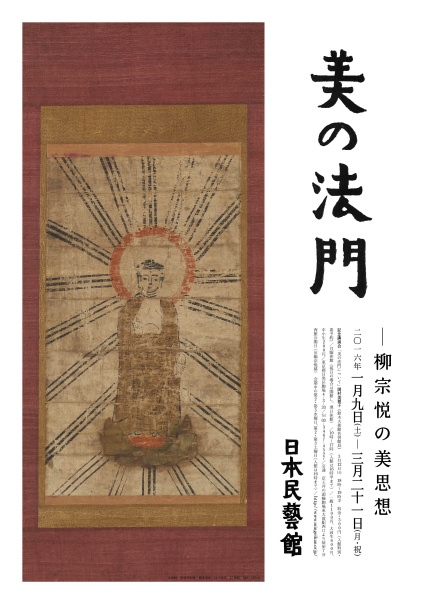
写真提供:日本民藝館 Photo courtesy of The Japan Folk Crafts Museum
思えば「美の法門」に出会う「伏線」はありました。私は中学・高校時代を、浄土真宗大谷派系の学校で過ごしました。所属は美術科で、仏教と美が交差する学び舎でした。宗教行事や勤行のことも、当時見た色々な展覧会のことも、懐かしく思い出します。民藝の世界に、出会う前から出会っていたご縁の不思議さを思うことしきりです。
さて、上記の「美の法門」体験から早くも10年以上が過ぎました。私は民藝の研究者になり、旧・東京工業大学の博士課程を修了して博士号を取得し、民藝に関する著書(『柳宗悦 無地の美学』専修大学出版局、2025年)も刊行しました。
しかし、いつ「民藝」に出会ったのか、「民藝」とは何なのか、と言われると、正直なところ、よくわからなくなります。私にとっては、仏教美学と美しい物に出会ったということが主で、重要です。その為、「民藝」というカテゴライズにはあまりこだわってこなかったところがあります。この姿勢は、今後も大きく変わることはないでしょう。
柳にとって仏教美学は、「直観的基礎」に支えられる、新たな「学」の模索でした(「仏教美学について」、1959年)。単なる情報の列挙や分析ではない、美と実在の探求としての「学」。学術コミュニティの内輪でのみ流通するのではない、美意識とビジョンの発信としての「学」。「物」や「私」という虚仮なる存在を媒介にしながら、無限なるものを見つめ、真善美を世に問う―仏教美学において、学術と求道、普遍と個は矛盾しません。
AIなどの発達で、データの収集と分析は今後一層容易になるでしょう。しかし、美の蒐集と直視は、容易には代替され難い。そこにこそ、民藝はある筈です。この位相への開かれを追い求めていきたいと感じます。
(佐々風太/東京科学大学 特別研究員、日本民藝協会 機関誌『民藝』編集委員)
The first work by Sōetsu Yanagi that I read was The Dharma Gate of Beauty (Bi no Hōmon), published in 1949. It was included in Forty Years of Mingei (Mingei Yonjūnen, Iwanami Bunko, 1984).
If I should attain Buddhahood,
If there are, throughout my land,
among humans and heavenly beings,
those whose forms and appearances differ,
some beautiful and some ugly,
then may I not attain perfect enlightenment.
“When these words exist, surely they are enough to establish, on their basis, an school of beauty.”
I remember being awakened, almost jolted awake, by these words at the very beginning of the book. It was 2015, when I was a first-year student at Musashino Art University. It was sometime between summer and autumn, and I was eighteen or nineteen years old.
Around the same time, I visited the Japan Folk Crafts Museum and was deeply moved by the ceramics and by the harmony of the various objects arranged throughout the exhibition rooms. At the exhibition The Dharma Gate of Beauty: Sōetsu Yanagi's Philosophy of Beauty, held there in 2016, I found myself captivated by the Ido and Hakeme tea bowls.
Looking back, there had been a number of threads leading me toward The Dharma Gate of Beauty. I had spent my middle and high school years at schools affiliated with the Ōtani-ha school of Jōdo Shinshū Buddhism. I belonged to the art department, so it was a place of learning where Buddhism and beauty intersected. I fondly remember the religious ceremonies and regular sutra chanting, as well as the many exhibitions I saw during those years. I often find myself struck by the mysterious workings of affinity: somehow, I had already encountered the world of Mingei before I ever encountered it.
More than ten years have now passed since that experience with The Dharma Gate of Beauty. I became a researcher of Mingei, completed my doctoral studies at Institute of Science Tokyo (formerly Tokyo Institute of Technology), and earned a PhD. I have also published a book on Mingei, Sōetsu Yanagi: The Aesthetics of Plainness (Senshu University Press, 2025).
And yet, when someone asks me when I first encountered “Mingei,” or what exactly “Mingei” is, to be honest, I find myself no longer quite sure. For me, what has really mattered is that I encountered Buddhist aesthetics and beautiful things. For that reason, I have never been particularly attached to the categorization of “Mingei.” I do not think this attitude will change very much in the future.
For Yanagi, Buddhist Aesthetics was an attempt to seek out a new form of learning (gaku), one grounded in an aesthetic eye as foundation (“On Buddhist Aesthetics,” 1959). It was a form of learning understood not as a mere accumulation and analysis of information, but as an inquiry into beauty and reality. It was also a form of learning that was not meant merely to circulate within the confines of an academic community, but to communicate a sensibility and a vision of beauty.
Through such finite and provisional beings as “things” and “the self,” it gazes toward the infinite and asks the world to consider truth, goodness, and beauty. In Buddhist aesthetics, scholarship and the spiritual quest, the universal and the individual, do not contradict one another.
With the development of AI and other technologies, the collection and analysis of data will undoubtedly become easier than ever. Yet the collecting of beauty and the direct encounter with it are not so easily replaced.
That, surely, is where Mingei lies.
I want to continue pursuing an openness toward this dimension of experience.
Futa Sasa
Research Fellow, Institute for Liberal Arts, Institute of Science Tokyo
Editorial Committee Member, Mingei, journal of the Japan Folk Crafts Association